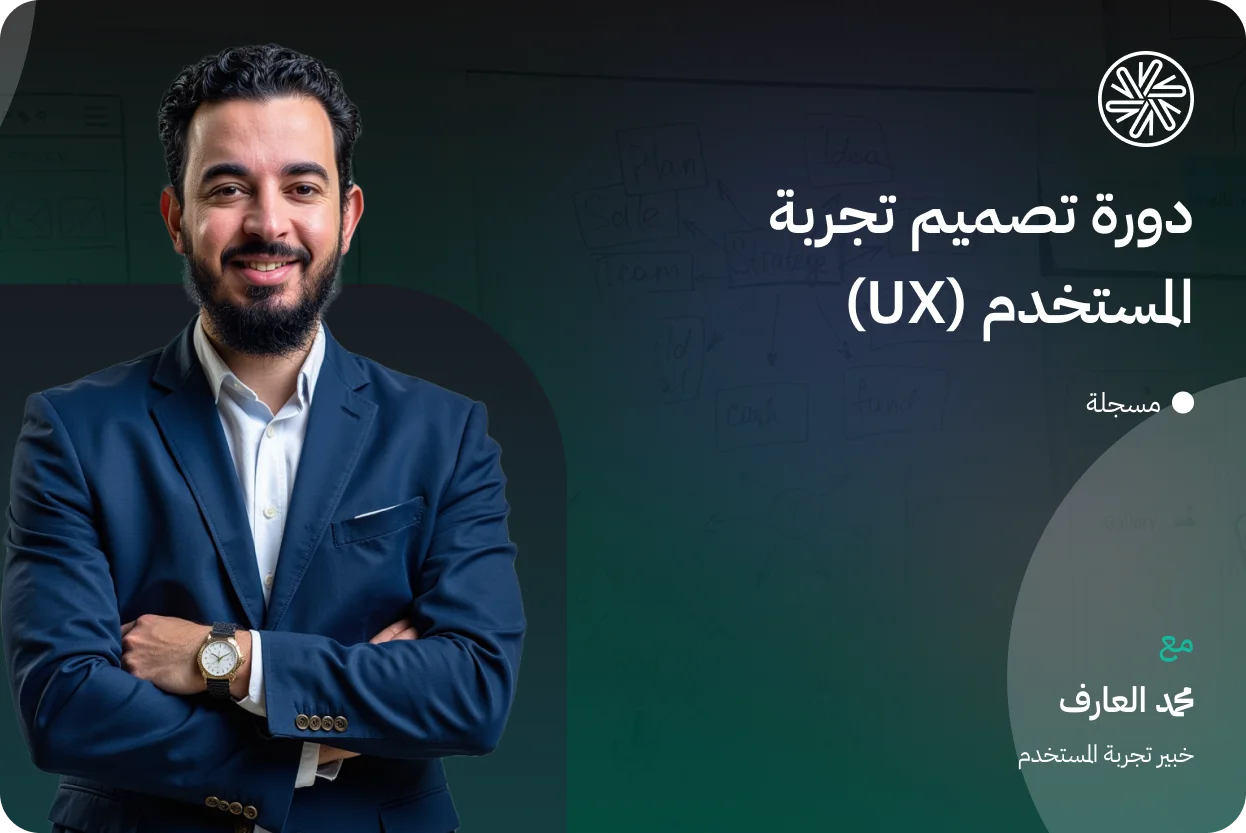
Benefit from over 70 hours of intensive, interactive training in this recorded course, and gain user experience design skills from the basics to advanced technologies through high-quality educational content and applied workshops.
duration
70 hours
price
12,000 SAR
About this course
Start your journey in the world of user experience design with a recorded course specifically designed to build your expertise from scratch.
What you will learn:
Basic user experience concepts and best practices
Analyze user needs and understand their behaviors
Design practical digital solutions focused on improving the experience
Applying skills through realistic projects and interactive exercises
What will you learn in this scholarship?
Basic UX principles, user research methods, product strategy building, and competitor analysis to understand the market and user needs.
Plan and conduct usability testing, write professional reports, and analyze results to continuously improve the user experience.
Build user personas, map the user journey, identify and organize problems, and apply creative techniques to find innovative solutions.
Build a professional portfolio, prepare a case study, write a distinctive CV, job search strategies and prepare for interviews.
قم ببناء محفظة مهنية، وإعداد دراسة حالة، وكتابة سيرة ذاتية مميزة، واستراتيجيات البحث عن عمل، والتحضير للمقابلات.
Work on a complete real application under the supervision of experts, while obtaining an accredited certificate and the opportunity to be nominated for employment in major companies.
Whose course is this?
Learning enthusiasts:Anyone who is committed, persistent, and has a passion for learning new technical skills
university graduates:From all disciplines who want to build a career in user experience design
College Students:From various disciplines seeking to develop their skills in the field of digital design
anyone:From within or outside the technical field and wants to enter the field of user experience design or digital product management
Professionals wishing to develop:Product managers, data analysts, project managers, digital marketers, and sales professionals who want to add user experience design skills to their professional expertise
Your comprehensive guide to entering the world of user experience design
Your educational path during the camp
Your educational journey - step by step towards mastery
Effective learning requires a clear and thoughtful plan. So we designed a gradual educational journey that starts with you from the basics and moves you towards mastery and professionalism.
Each stage is carefully designed to build your skills with confidence and give you a practical understanding applicable to real-life projects from day one.
1- Introduction to Camp Caradis
2- Introducing who I am
3- Questions that come to your mind.
4- Why are we here and what will we do
5 - Definition of user experience
6 - User Experience Terms
7- What do we mean by user research?
8 - What will accrue to the product / company?
9 - Types of user research
10 - Questions section
11- Episode opening and Roadmap of what will be learned in camp
12 - What are user interviews, and when do we use them
13 - Steps for planning and conducting a user interview.
14 - Rules for writing interview questions, Part One
15 - Rules for writing interview questions, Part Two
16 - Explanation of the basics of FigmaJam
17- Live session task for how to write goals, correct and specify notes
18 - The second task on how to write interview questions and notes on them
19 - Questions section
20 - Opening the episode and conducting user interviews
21 - Who are the people who will be interviewed
22 - Mechanism for arranging and preparing for the interview
23 - Simulation of user interviews, part one
24 - Simulation of user interviews, part two
25 - Task Live Session
26 - Notes on the Task
27 - Questions section
28 - Opening of the episode "Stakeholder Interviews".mp4
29 - What are stakeholder interviews?
30 - Who are the stakeholders?
31 - Why are stakeholder interviews important to the design process?
32 - Steps for interviewing stakeholders.
33 - What are the objectives of stakeholder interviews?
34 - Task Live Session for Stakeholder Interviews and Correction
35 - Preparing for stakeholder interview questions
36 - How to write stakeholder interview questions
37 - Questions section
38 - Episode opening and what is "competitor analysis"
39 - What is competitor analysis? Why is it important?
40 - Steps for conducting competitor analysis
41 - Practical application to competitor analysis
42 - Correction of the live session task, competitor analysis, part one
43 - Correction of Task Live Session, Competitor Analysis, Part Two
44 - Questions section
45 - افتتاحية الحلقة " ريكاب سريع " على ما فات
46 - ما هو استطلاع الرأي survey
47 - Examples of questionnaire forms
48 - Why is this type of research desirable?
49 - Steps for planning and conducting the survey
50 - Types of survey questions
51 - Live session task for writing questionnaire objectives.
52 - The best goals to use
53 - How to formulate questionnaire questions
54 - Formulating the questionnaire questions correctly and answering them
55 - Questions section
56 - Episode opening: Recap on what was missed
57 - What is the stage of filtering information
58 - A practical application on Task Live Session for information filtering, Part One
59 - The second part of the application on the "capsule" information filtering task
60 - Questions section
61 - Episode opening and review of what was missed
62 - What is Persona
63 - Steps to build Persona
64 - Practical application on Persona, Part One
65 - Practical application of Persona, Part Two
66 - Questions section
67 - Episode opening: "Recap on what's past"
68 - What are convergence maps?
69 - Practical application on convergence maps, Part One
70 - Practical application on convergence maps, Part Two
71 - Questions section
72 - Episode opening
73 - What is a customer journey map
74 - Components of a customer journey map
75 - A practical application on the customer journey map, Part One
76 - A practical application on the customer journey map, Part Two
77 - A practical application on the customer journey map, Part Three
78 - Questions paragraph
79 - Episode opening: "Determining problem priorities"
80 - How to determine problem priorities, Part One
81 - How to determine problem priorities, Part Two
82 - Task Live Session to Determine Problem Priorities, Part One
83 - Task Live Session to Determine Problem Priorities, Part Two
84 - Live Session Task Correction
85 - Questions section
86 - Episode opening
87 - What is HMW`S technology
88 - Implementing the HMW`S technique, practical, part one
89 - Implementing the HMW`S Technique Practical Part Two
90 - Implementing the HMW`S Technique Practical Part Three
91 - Correction of the Live Session Task, Part One
92 - Correction of Task Live Session Part Two
93 - Questions section
94 - Episode opening
95 - What is the impact effect matrix technique
96 - Practical application of the impact effect matrix technique
97 - Live Session Task Correction
98 - What is the structure or architecture of information
99 - Types of people who use applications/and on what basis the information is arranged
100 - Questions section
101 - Episode opening
102 - What is Card Sorting
103 - What are the types of Card Sorting
104 - Practical application on the Card Sorting Task, Part One
105 - Practical application on the Card Sorting Task, Part Two
106 - Practical application on the Card Sorting Task, Part Three
107 - Practical application on the Card Sorting Task, Part Four
108 - Practical application on the Card Sorting Task, Part Five
109 - Practical application on the Card Sorting Task, Part Six
110 - Questions section
111 - افتتاحية الحلقة
112 - What are User Flow Keys
113 - Practical Application to User Flow Part 1
114 - Practical Application to User Flow Part II
115 - Practical Application to User Flow Part III
116 - Live Session Task Correction
117 - Questions paragraph
118 - Episode opening, and what is Wireframe
119 - What are the types of prototypes
120 - Practical explanation of prototypes, part one
121 - Practical explanation of prototypes, Part Two
122 - Questions paragraph
Your experts on this educational journey
Muhammad Al-Arif
User Experience Manager and Design Systems Expert
I have over 20 years of experience designing hands-on and fun digital experiences, and have a unique set of skills that include: design strategy, user research, information structuring, content strategy, user interface design, and usability testing. Lead customers and teams from ambiguity to clarity by establishing a clear vision that combines user needs, business goals, and technical requirements.
Leave your review
Graduates' opinions
Lubna Kutbi
Country: Saudi Arabia
21 July, 2024
المعسكر رائع ومثري والشكر للاستاذين محمد العارف ومحمود فكري وأيضا تبادل الخبرات والمعرفة مع اعضاء الفريق.
هناك بعض النقاط التي اتمنى تحسينها، اولا الالتزام بالوقت حيث كثير من الأحيان تتأخر استراحةPrayer and also sometimes the entire lecture time from 8 to 12 is exhausting!
Shorouk Ahmed Fahim
Country: Egypt
25 January, 2025
The experience was very fruitful. I liked the style, the giving provided, and the explanation. Thank God, at first I was a little nervous because the pressure eased for 3 months, but thank God I felt that I was charging my energy and not getting tiredAlso, it was the first time I started working as a freelancer in addition to my main job, and I took a business course here. It helped me a lot. The foundation and concept were very useful to me. I mean, it wasn't just in the field of UX. I really liked the concept and the mentality because I love this method and organizing my thoughts. The foundation wasn't preserved or forced to do anything real. I am happy, thank God, with this very fruitful experience
سارة طارق محفوظ
Country: Egypt
27 December, 2025
المعسكر ده خلاني أعيد تفكيري في أبسط الحاجات زي اللون والخط والمقاسات
اتعلمت إزاي الـ Design Tokens مش بس بتوفر وقت، لكن كمان بتحافظ على الهوية، وبتسهل التعاون بين الـ designersوالـ developers.
شكرا كراديس، على تجربة منظمة، مفيدة، وخفيفة على القلب ❤️
The best companies in the region that employ our graduates
We are proud that our graduates join the ranks of the best companies in the region, where their skills and creative thinking are valued. Through hands-on training and job market-friendly curricula, we prepare our students for professional success from day one.
FAQ
Got questions? Here are her answers.
Do I need prior experience in user experience design?
No, this is a registered foundation course designed for beginners. We start from the basics and learn naturally through structured videos, making it suitable for anyone who wants to enter the UX field.
How long is the course and how can I access it?
The course contains high-quality recorded content that you can access at any time. You learn at your own pace without time restrictions, with lifetime access to content from anywhere in the world.
Will I receive an accredited certificate after completing the course?
Yes, you will receive a Cradis Certified Certificate in Foundation User Experience Design after successfully completing all course modules and practical applications.
What is the difference between this recorded course and interactive camps?
A registered course gives you complete flexibility in learning at your pace, with structured and focused content. While interactive camps include live sessions and interaction with trainers and participants, a recorded course provides the same quality of content with greater flexibility.
Can I interact with coaches or ask questions?
The course is fully recorded, but includes comprehensive and detailed content that answers most frequently asked questions. You can also refer to the content and rewatch it any number of times to ensure full understanding.
How much time do I need per week to complete the course?
Since it is a recorded course, you can set your own learning pace. We recommend allocating 3-5 hours per week for best results, with the ability to speed up or slow down depending on your personal schedule.
How much does the course cost and what payment methods are available?
A recorded course costs less than interactive camps with the same quality of content. We offer a variety of flexible payment options. To get the current price and available payment methods, contact your sales team for a personalized offer.
Sign In
أوافق على تخزين بياناتي ومعالجتها بواسطة هذا الموقع.
Privacy Policy